Tuesday, May 19, 2015

Cooking with kids

When we're busy trying to get dinner ready at the end of a long day, children often seem more "in the way" than helpful!  That, of course, is completely understandable.  Did you know, though, that children can learn a LOT during cooking experiences?

Many of Indiana's early childhood standards for math, science and language arts can be reached through children's experiences with food and cooking.  For example, counting out 4 cups of flour teaches children not only about measurement and counting, but also one-to-one correspondence (the concept that we count one number for one scoop of flour.)  If you've ever tried to play a board game like Candy Land with your young child, you have seen a lack of one-to-one correspondence when they move 12 spaces while counting to 5!

Indiana's science standards ask us to allow children to investigate and talk about the characteristics of matter.  What's the difference between oil and water?  They are both liquids, but they act very differently.  What happens when we mix them in a recipe?  Flour and salt are both white, but they feel differently when touched.  Science standards also ask us to give small groups of children opportunities to engage in scientific experimentation.  Mixing ingredients for a recipe, adding heat (which causes a chemical reaction) and then observing (tasting!) those changes certainly meets this criteria.


When following a recipe, children also have the opportunity to meet language arts standards, and working with a small group helps them gain important social/emotional skills as they take turns with friends. 

How can you extend this learning at home? We know it's unlikely that you'll be able to fit in cooking experiences with your child at home after a long day at work, but perhaps on a weekend you'll find some ways that your child can help out in the kitchen with a simple recipe you can make together!

Need some additional resources?  Look here for additional things children learn while cooking, and here for some fantastic recipes and other information!

Thursday, May 14, 2015

Observational Drawing with Young Children - a scientific process

Besides art, drawing can be used for more scientific purposes, too.  One of the ways we use drawing with children at the YCCF is in the process of "observational drawings."  Children at the art table often draw for fun and to express their thoughts and ideas.  While this is a vitally important experience for children to have, there is another reason (and way) to use drawing.

Observational drawing is the experience of looking closely at something-- and drawing what you see.  We use this type of drawing for a different reasons, but generally, it is intended to help children focus on what it is they are looking at, to notice the different elements of the object(s) and to create a representation in order to help them better understand it. 

These drawings represent preschool children's  observations of tadpoles in their early stage of development.  In the coming days and weeks, the children will watch as the tadpoles change-- as they first grow legs, then lose their tails, and ultimately become frogs.  As this happens, children will have the opportunity to watch and sketch the changes.  They will record, as scientists do, their observations onto paper so that they can reflect on the changes they saw.  Teachers will ask questions, "What's different now about the tadpoles? Let's look at the drawings from last week and see what changes have happened." 

How can you extend the learning at home?  Help your child notice the phenomena that happen all around him.  Give her a clipboard and pencil to sketch things they see and wonder about in the world.  For very young children, it is helpful to choose parts of things to sketch instead of entire objects (e.g.- sketch the wheel of the car, not the whole car.)  Talk about and label the parts of things that you see if your child is interested.  This is yet another opportunity to expand her vocabulary!  Compare his drawings of one tree/bird/truck to other ones you see.  How are they alike and how are they different?  Refrain from giving your child suggestions about how to approach her drawing.  Learning to draw is a developmental process-- one that takes time and practice, and each child goes about this in his own way. 

Wednesday, May 6, 2015

But what is it? Understanding and responding to children's art

Do you have one of those kids who come home with a huge pile of artwork everyday?  Paintings, drawings, teeny-tiny scraps of purple, red and yellow?  Or maybe your child brings home just one "jewel-encrusted" piece of construction paper, sopping with glue still, that they insisted you bring home instead of allowing to dry in the classroom? 

For older children, sometimes this art work is easily recognizable, but for many children in the early childhood years, the paintings are gray or brown blobs, or simply scribbles all across the paper.  As adults, we're using to considering art as a representation of something, so we're tempted to ask our children, "What is it?"  Here's the surprising news:  sometimes it (really) isn't anything at all, and more importantly, it's just fine if it isn't anything at all! If that's the case, though, how do we respond when our children enthusiastically show us their painting or drawing?
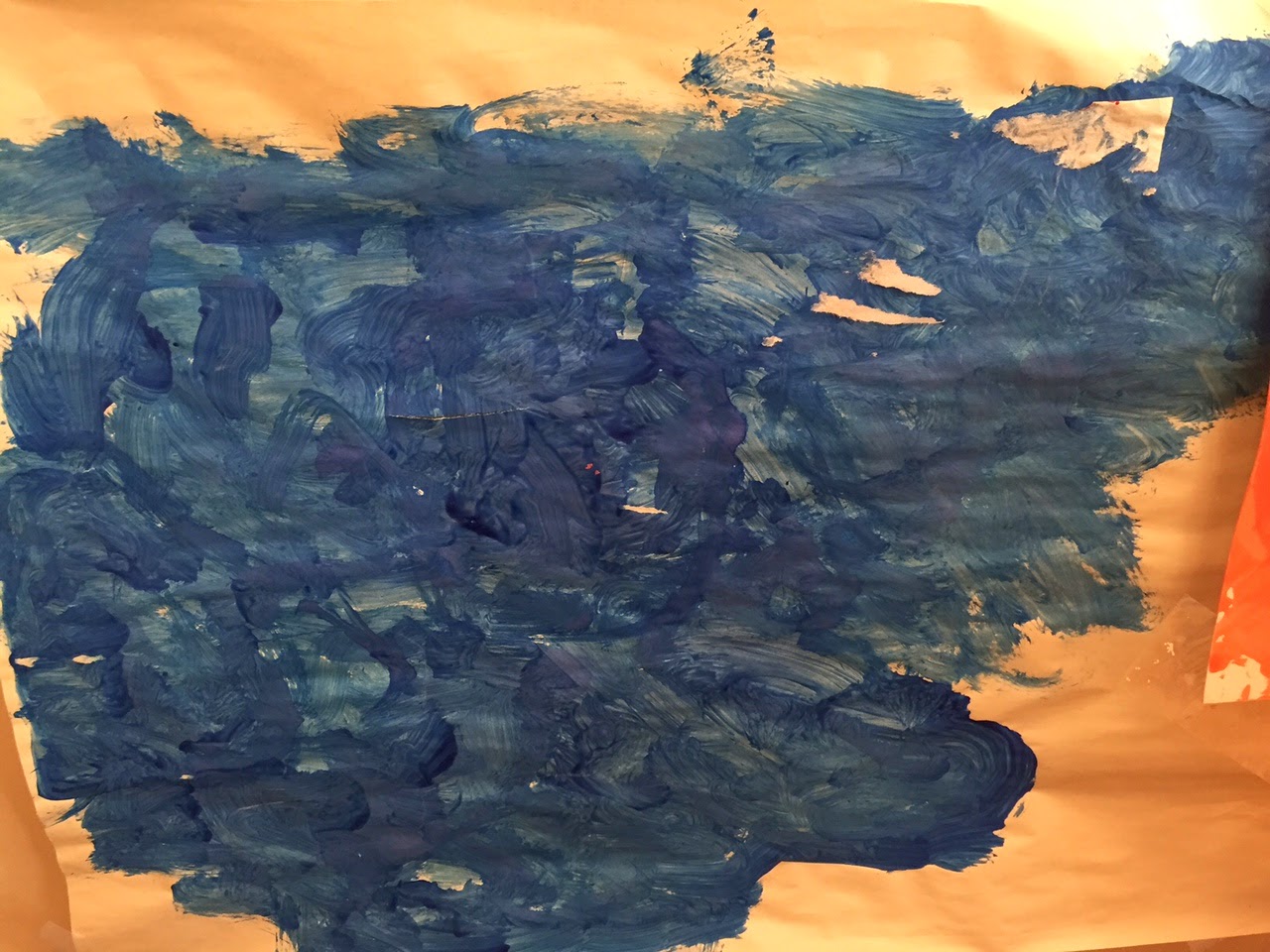
Very often, art work is an exercise of process for children; they are not always working towards a product.  Art materials like paint, clay, glue, markers and other drawing materials are fun just to explore and "see what happens" on the paper.  That's why you'll so often see big blobs of gray or brown.  What you don't see is the twenty minutes the child spent adding blue to yellow to make green, and then adding red, just to see what happened.  (Brown happens when you add all three primary colors.) From this experimentation process, children learn a LOT.  They learn about the qualities and properties of the medium they are working with. They learn how oil pastels feel slippery compared to crayons. They learn that the viscosity of finger paint is different than tempera.  They learn what happens when you add blue to yellow (and if you were in the classroom, you'd hear their exciting discoveries as they cry out, "Green! I made green! Look, it's green!" They figure out (eventually!) how much glue you really need to hold that feather onto the construction paper. They learn about straight lines and circles and they gain lots of fine motor control as they learn to manipulate their paintbrush, marker or pencil (yes, this will help them with writing later, but this isn't even the most important part of the experience of art!)  More importantly though, they learn that art can be a way to express feelings and beauty and eventually, that it can be used to represent ideas.
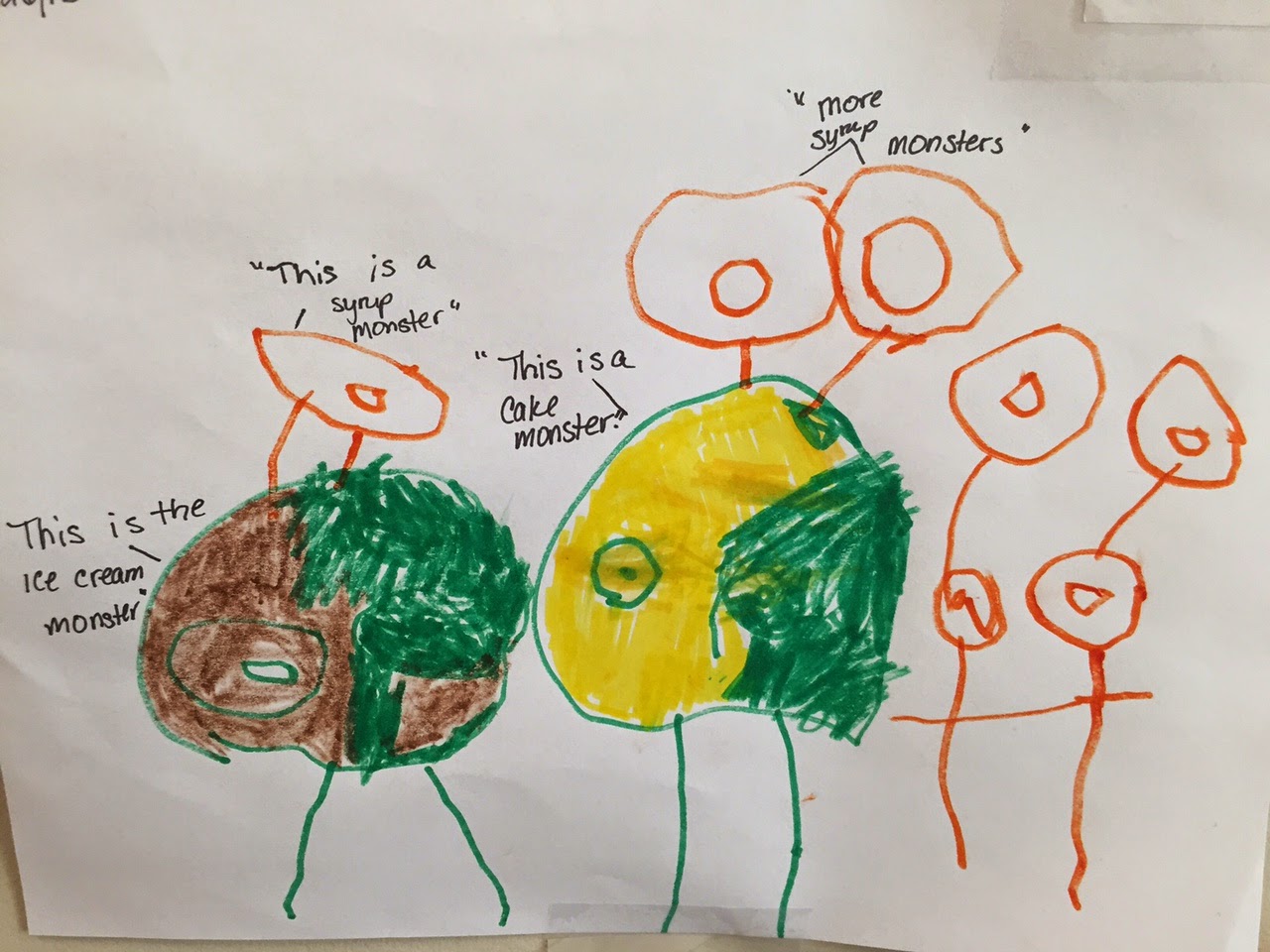
"This is the ice cream monster. This is the syrup monster.
This is a cake monster.  More syrup monsters.

So how do we talk to children about their art?  One of the easiest ways to go is to simply tell your child what you notice about his or her art.  "Oh, I see you used a lot of BLUE on this painting," or "I notice that you used a lot of CIRCLE shapes here."  Noticing what a child does in this simple manner supports the process of what they've done because in doing so you have demonstrated a non-judgmental appreciation of what they've done.  It can also expand their vocabulary. Instead of "blue," say "slate-blue," instead of noticing a green-yellow color, say "I see you've made chartreuse!"

But what is it? As long as you keep noticing things about their work, children will tell you "what is it," when and if it is something!  If you ask, "what is it?" children who aren't yet creating representations with their art are likely to just make up something they think you'd like to hear.  And unfortunately, if they weren't representing, but just experimenting, it also sends the message that their art should "be something," and that they did it incorrectly.  So just enjoy noticing. And when you're done, they'll very likely want to tell you more things about their art work.  And they'll keep on creating!

Friday, May 1, 2015

Preschoolers conduct a ball study

 
Measuring the circumference of the football with tape
 When choosing what to study in preschool, following children's interests tops our list!  When children are allowed to pursue knowledge related to things that are interesting and relevant to their lives, they, just like adults, stay focused and can get so much more out of the process.

The Sycamore Preschool is currently doing a study of balls-- footballs, baseballs, basketballs, soccer balls and more.  In this activity, they are considering the sizes of each of the balls.

Comparing the circumference of each ball
 Children talked about the idea of circumference, or how big around each of the balls were.  They used colored tape to "measure" around each one.  Then, they lined up their tape measurements to compare which ball had the largest circumference, and which ball had the smallest circumference and which were in between. 

When children explore a concept like circumference in early childhood, it deepens their understanding of it when they learn this concept more formally in the upper elementary grades.  Compared to children who haven't had this experience, these preschool children will "get it" much more intuitively.

Children line up the balls in order of size
After measuring the circumference, the children lined up the balls in order of size (a math skill called "seriation.") 

In this process, children have the opportunity to talk about "big, bigger, biggest," and "small, smaller, smallest."  In addition, they have the opportunity to use their social-emotional skills to discuss their opinions and ideas about where each ball fits on the continuum, and solve such problems as the best way to measure the circumference of a football-- around the middle or across the ends?

How can you support this learning at home? Watch your child at play.  What is she interested in?  Ask your child, "what do you wonder about that?" Sometimes we have to demonstrate intentional curiosity by posing our own questions.  For example, if your child is thrilled to find an interesting nest of ants on the sidewalk, you can pose your own questions.  "I wonder why the ants are all gathered here on the sidewalk? I wonder what they are doing?"  It's likely that your child will have some ideas, maybe even silly ones, to offer.  Instead of just telling your child the answer, or discrediting his theory, spend some time just observing the ants.  Or even ask your child, "I wonder how we could find out?" Being curious with your child helps them understand that they can be in charge of their own learning.  They can be researchers who found out the answers to their own questions.  The intellectual pursuit of knowledge was never so interesting!

Monday, April 27, 2015

Painting the clouds


Focusing on his work.
Our Maple Room two-and-three-year-olds have been enjoying the outdoors this spring!  One day this week, I found them out at the picnic tables deeply engaged in an activity with mirrors and shaving cream. 

Shaving cream is an engrossing sensory experience for children who are old enough to keep it out of their mouths (usually about 2 or 2 1/2 and up).  On this sunny, but partly cloudy day, teachers Alex and Hannah took child-safe mirrors outside on the picnic tables.  

A close-up.  Shaving cream is great for touching, too.

The children were able to see the reflections of the clouds in the mirrors on the tables, and they used the shaving cream to "paint" what they saw.

 Children were able to observe the clouds above in a very different way, and use shaving cream to create their own representations of clouds.

Observing the world around them is a natural thing that young children do, and teachers help by extending that experience by talking to them about what they see, adding new vocabulary words and giving children the opportunity to express themselves artistically.

When children learn that a drawing or painting
can "represent" something else, they are making 
Cloud painting can be a social activity.
strides toward that same understanding that will help them to learn to read later. (Letters make up words that abstractly represent something else.)

They can also learn new vocabulary, like "wispy" and "fluffy" or even "cumulus," "stratus," and "cirrus." 

How can you help at home? What can you observe outside with your child?  Take a table outside with crayons and paper, or hand over a clipboard and pencil and let your child draw what she sees (no coloring sheets necessary!) 


Wednesday, April 22, 2015

Dress for mess! Sensory play at school


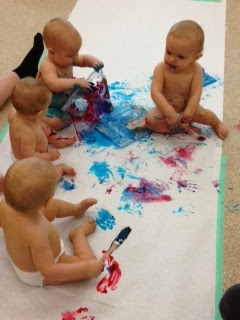
Babies exploring non-toxic paint, together.
I always tell our new families to be sure that their children come to school dressed for mess! Children have the opportunity to use all of their senses to explore a variety of materials, many of them messy, every day at our school.  Some parents embrace the idea, and for others, it can take a little bit of persuasion.

The idea of messy play is so important to us at the YCCF that we put it into our policy manual, so families understand that their children are likely to get paint, water, mud, soap, play dough or glue on their clothing during the day. 

Why do we think it's so important? We know that children learn best when they can engage all of their senses in their exploration of the world.  And materials with interesting textures are the most engaging of all. Materials that children love include paint (especially finger paint), shaving cream, mud, water, uncooked rice, dried beans, and various recipes for play dough, "goop" and "gak."  There's even one we call "ooblek!"

Sensory play uses big and small muscles. When children explore with these materials, they use not only the small muscles of their fingers and hands, but also the larger muscles of their arms as they move, squish, dump and pile the materials. And when the sensory experience involves a rain puddle, mud puddle, or sandbox, their whole body gets involved! There's also something extremely soothing about sensory experiences-- both for adults and young children.  Letting a big handful of dry rice fall through your fingers is inherently attractive to us. It just feels good. Petting a soft, silky cat calms us.  When teachers come to me because a child has a challenging behavior, I very often ask, "What sensory materials do you have out?"

Toddlers explore soapy water.
Sensory play is a social activity.  Most of the time, when children explore these materials, they do it together.  Whether it's toddlers around the water table or babies painting together on a giant piece of paper, this social activity gives children the opportunity to share an experience together.  They have opportunities to ask for what they need and to help out a friend.  When one asks, "Can I have the star cookie cutter?" at the play dough table, and another child helps out by handing it over, children learn the social-emotional skills they need to get along with others.

Sensory play teaches language. It would be  impossible to understand words like "squishy," "soft," "slippery," or "silky" without having repeated sensory experiences with materials that match those descriptions.  The same goes for "prickly," "rough" and so many more.

Sensory play teaches foundational science.  While you might not think physics or chemistry has a place in a preschool or toddler room, actually,  foundational science is a big part of sensory play! Pouring water from a short, fat cup into a tall, thin cylinder helps children understand the concept of conservation of liquids. Adding rocks to a full pitcher of water makes the water inside overflow, helping children understand displacement.  And that's only the beginning.

How can you help at home? Give your children opportunities with safe sensory materials to play with.  Fill a plastic tub with water and give them cups and spoons from your baking drawer.  Recipes for play dough can be made at home, inexpensively.  Add some cookie-cutters and a rolling pin. Talk with your children about their experience with the sensory material.  How does it feel?  What can you do with it?  What properties does it have? Need some specific ideas?  Visit Learning4Kids for recipes!

There is so much in a young child's world that is a "no-no!" or a "don't touch!" Let's tell them YES to sensory play!

Friday, April 17, 2015

Raising Readers, Part 1

One of the most frequent questions I get from families revolves around that big school-readiness question: "How do I help my child get ready for reading?" 

We rarely worry about whether our children will learn to talk or not, and sure enough, somewhere around 16 - 18 months they start to chatting away with seemingly little effort from us. But for some reason the idea of learning to read drives us to purchase worksheets and flashcards for our little ones! The question is, is this worry necessary?

Ultimately, learning to read is an important milestone for our children.  Most children learn to read sometime between 5 and 7.  Reading, and reading well, is vital for success in school and life.

So, how do we support our children, and when do we start?  Literacy learning starts right from birth, and occurs in a very similar way to oral  language learning.  Children learn to talk when they are surrounded by meaningful language-- especially dialogue that occurs between parent or caregiver and child.  Much like a tennis game, back-and-forth dialogue between a child and an attentive adult teaches a child that language is communication between people.  It carries meaning and it helps to build a relationship, even when the child's side of the conversation consists of babbles and squeals.

Similarly, children learn the early foundational literacy skills when they are surrounded by meaningful print language-- books, signs and more.  When we write a shopping list for the groceries, type out an email, read a book or use street signs to find the right road, we use print language for meaningful purposes.  And for children, meaningful print is important print.  When it's important to you, it becomes important to them, and they become interested and therefore motivated to learn about it.

How do we help you child use meaningful print language at school?  Right from the start you will see print used in your child's classroom.  Areas of the room are labeled-- "blocks," "dramatic play," or "science center."  Children's ideas are written down on lists posted around the room or on their paintings or drawings.  Children write letters to thank visitors for coming to their classroom.  Bins for toys are labeled with the names of the contents to help children clean up.  Stories are read and enjoyed.

How can you use meaningful print at home? Talk with your child about print when you use it.  If you're making a grocery list, announce to your child, "I'm making a list of things we need to buy at the grocery store. Can you help me think of things we need to include?"  As your child helps you with items, let her watch you write them on the list.  When driving, ask your children help you find the street sign for your road.  At the department store, tell them you're looking for the "men's" clothing, and point out the signs hanging from the ceiling.  And of course, read, read, read!  Read to them; read for pleasure; let them see you read for all kinds of reasons.  Make print important in your home - important for you and important for your children.

Learning to read can seem complex, but there are lots of things you can do to help.  This is just the start! Next time, I'll share about the role of vocabulary-building and experience in learning to read.

How do you make print meaningful in your home?